
Fall in Maine brings cooler days, changing leaves—and, for many households, a familiar worry: What will it cost to heat the house this winter?
For families already stretching each paycheck to cover housing, groceries, child care, transportation, health care and other necessities, a higher utility or heating bill isn’t simply an inconvenience. It can mean deciding which expense will have to wait.
That reality is part of what United Way seeks to better understand through ALICE.
ALICE stands for Asset Limited, Income Constrained, Employed: households that earn more than the Federal Poverty Level, but not enough to afford the basic cost of living where they live.
According to the latest ALICE data, 35% of households in Kennebec County were below the ALICE Threshold in 2024. That includes 23% of households that were ALICE and another 12% living below the Federal Poverty Level.
That’s more than one in three households in our community struggling to afford the basics.
What does it actually cost to get by?
The ALICE Household Survival Budget estimates the minimum cost of household essentials in Kennebec County, including housing, child care, food, transportation, health care and technology, plus taxes and a small allowance for miscellaneous expenses.
Based on the most recent data, a single adult in Kennebec County needed an estimated $32,052 a year, or $16.03 per hour, just to cover that basic household budget.
For two adults with two children, the annual cost was $72,084. When both children required child care, it climbed to $86,640—or $7,220 every month.
And this is a survival budget, not a comfortable one. It doesn’t account for many of the things families may hope to plan for, such as emergency savings, college or retirement.
That leaves little room when something changes. A car needs an unexpected repair. Rent increases. A child gets sick and a parent misses work. Groceries cost more than expected. Or temperatures drop and the heating bill arrives. For households already living close to the line, one additional expense can force difficult choices among necessities.
From understanding the challenge to taking action with Impact2032
For United Way of Kennebec Valley, ALICE does more than help us understand the challenges facing local households. It also helps inform where we focus our collective efforts.
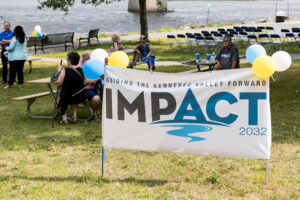
Financial stability is one of the three priority areas of Impact2032, our community-wide effort to improve the health, education, and financial stability of people across Kennebec County. Through the Impact2032 Financial Stability Cabinet, partners from across sectors are working together to better understand the barriers keeping local households from becoming financially stable and identify opportunities for coordinated action.
As the Cabinet moves from planning into action, its work is becoming increasingly focused on some of the same pressures reflected in the ALICE data.
Housing is one example. The Cabinet is preparing to examine the issue from two directions: how our community can support increased housing supply, and how we can improve the systems that help people access housing, move through periods of housing instability and remain stably housed.
Child care is another interconnected challenge the Cabinet expects to explore as its work develops—recognizing the significant role that access to affordable child care can play in a household’s ability to work and achieve financial stability.
These challenges don’t exist independently of one another. A household spending more on housing has less available for food or transportation. A lack of affordable child care can affect a parent’s ability to work. And as temperatures fall, heating and utility costs can put even more pressure on an already tight household budget.
That’s why understanding ALICE matters.
As we head into another Maine heating season, some of these pressures become especially visible. But for thousands of households across Kennebec County, the difficult choices aren’t limited to the colder months.
Understanding what it truly takes to get by—and using that understanding to guide collective action—is an important step toward building a Kennebec County where more people have the opportunity not just to make ends meet, but to become financially stable and thrive.